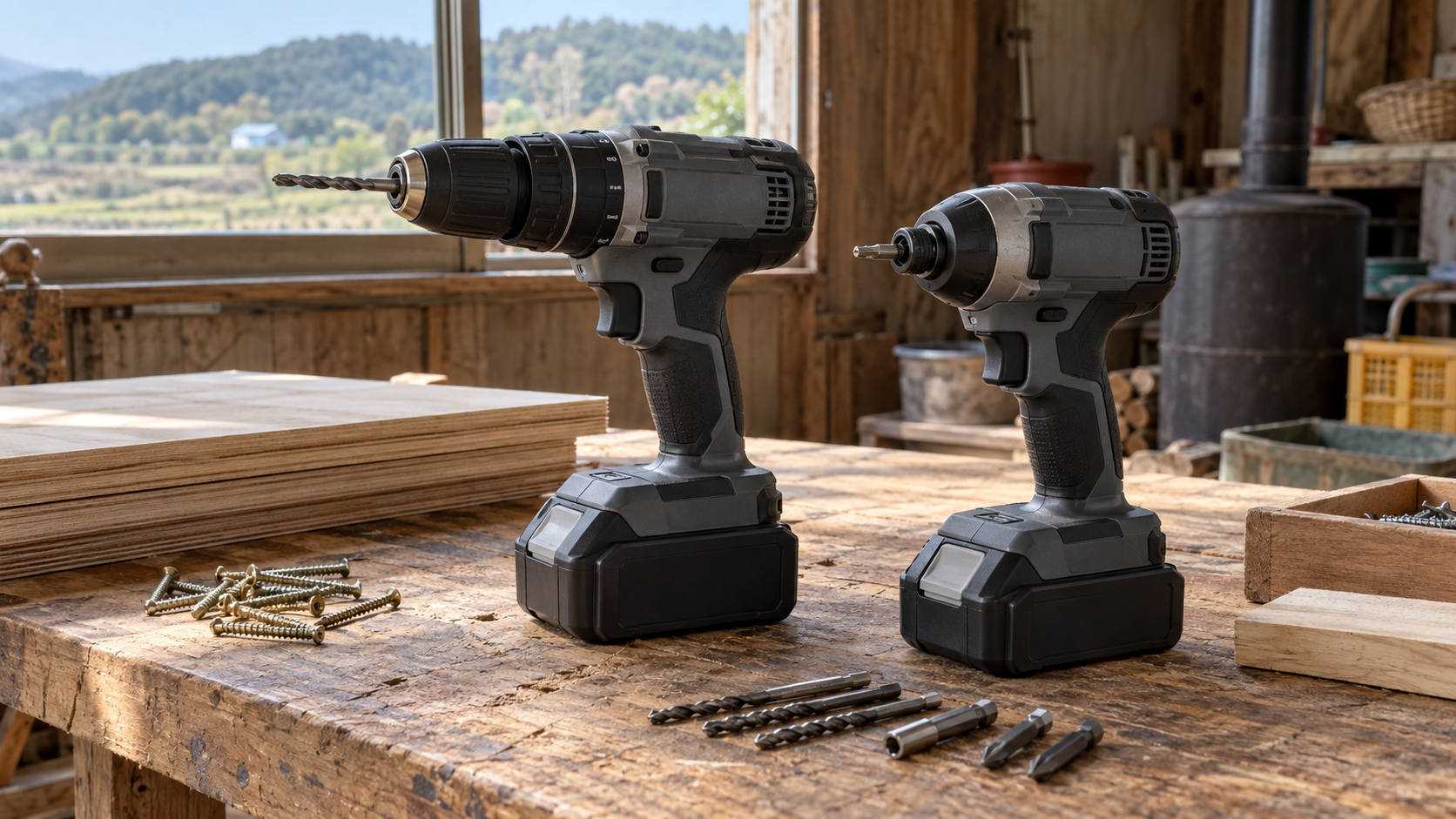
A guide to choosing a cordless drill for farm-shed shelves, greenhouse fixings, stakes and deck repairs: drill driver vs impact driver vs hammer drill, 12V vs 18V torque from Bosch, Makita and DeWALT specs, what 20V MAX means, October 2026 Coupang prices, and battery storage temperatures for a cold shed.
Before winter, farm-shed repairs pile up: a wobbly shelf to refasten, greenhouse fittings to secure, loose deck boards to screw down. A few dozen screws by hand and your wrist gives out first. So you look for a cordless drill, and find drill drivers, impact drivers, hammer drills, 12V, 18V, 20V and 21V. Which one do you actually need?
Bottom line: For farm-shed and garden DIY, one 18V (20V MAX) drill driver is the right first tool. It drills holes and drives screws, and the clutch controls the force. Add an impact driver if you drive many long screws into decking or treated timber. If you need holes in brick or block, choose a model with a hammer (combi) mode. If you already own batteries for a trimmer, sprayer or chainsaw, matching the same brand and voltage saves the most. Do not leave batteries in an unheated shed in winter: DeWALT says not to store them where it falls below 4°C.
Earlier notes: see cordless sprayers and trimmers on one battery, how to choose a cordless chainsaw 2026, and cordless vs engine leaf blowers.
1. Drill driver, impact driver, hammer drill: what is the difference?
They look alike but do different jobs. Based on manufacturer explanations:
| Type | What it does | Bit holder | Best for |
|---|---|---|---|
| Drill driver | Drills holes, drives and removes screws | Chuck (round and hex bits) | Shelves, furniture, thin sheet metal, precise screws |
| Impact driver | Rotation plus hammer blows for high torque | 1/4-inch hex holder | Long screws, treated timber, decking, bolts |
| Combi (hammer) drill | Pounds the bit forward while rotating | Chuck | Holes in brick and block |
| Rotary hammer (SDS) | Air-cushion piston delivers strong blows | SDS only | Reinforced concrete |
Bosch describes a drill driver as having two functions: loosening or tightening screws and drilling holes. An impact driver uses a hammer-and-anvil mechanism to deliver more torque and takes 1/4-inch hex-shank bits. Bosch notes it is designed mainly for fastening and generally does not accept round-shank drill bits, but suits long screws, lag bolts and pressure-treated wood.
A combi drill pounds the bit forward while rotating, which gets through brick. Bosch’s own pages differ on lightweight concrete, so the safe summary is: brick and block yes, reinforced concrete is rotary-hammer territory. Precision runs the other way. Bosch says a regular cordless drill drives screws far more precisely than an impact tool, so for thin plywood or furniture where screw heads must not strip, use the drill driver.
2. 12V vs 18V by the numbers.
Voltage sets both power and weight. From official manufacturer specs:
| Model (published specs) | Type | Voltage | Max torque (hard / soft) | Weight | Chuck |
|---|---|---|---|---|---|
| Bosch GSR 12V-30 | Drill driver | 12V | 30 / 18 N·m | 0.72 kg (no battery) | 0.8–10 mm |
| Makita DF333D | Drill driver | 12V | 30 / 14 N·m | 1.2 kg (with battery) | 10 mm |
| Bosch GSR 18V-55 | Drill driver | 18V | 55 / 28 N·m | 1 kg (no battery) | 1.5–13 mm |
| Bosch GSB 18V-55 | Combi drill | 18V | 55 / 28 N·m | 1 kg (no battery) | 1.5–13 mm |
| Bosch GDR 12V-105 | Impact driver | 12V | 105 N·m | 0.96 kg (with battery) | 1/4” hex |
| Makita TD110D | Impact driver | 12V | 110 N·m | 1.0 kg (with battery) | 1/4” hex |
| DeWALT DCF850 | Impact driver | 18V | 205 N·m | 0.95 kg (no battery) | 1/4” hex |
Within one brand, the 18V drill driver has close to twice the torque of the 12V one, and the chuck grows from 10 mm to 13 mm for larger bits. The Bosch GSR 18V-55 drills 35 mm in wood and 13 mm in steel and drives screws up to 10 mm. The 12V Makita DF333D manages 21 mm in wood and 10 mm in steel. Impact drivers exceed 100 N·m even at 12V and pass 200 N·m at 18V.
Matching the tool to the job
- Indoor shelves, furniture assembly, cabinet hinges, light fittings: a 12V drill driver is enough, and lighter on the hands.
- Deck boards, treated-timber fences, wooden greenhouse door frames, fixing stakes: lots of long screws. An 18V drill driver or an impact driver is easier.
- Anchors in block walls or brick: an 18V drill with hammer mode. For holes in a concrete foundation, rent an SDS rotary hammer.
If you buy only one tool, make it an 18V drill driver, ideally with hammer mode. It does holes and screws, and the 13 mm chuck takes a wide range of bits. The impact driver is the second tool.
What do 20V MAX and 21V mean?
DeWALT states that its “20V MAX” figure is the maximum initial voltage measured without load, and that nominal voltage is 18V. So 20V MAX and 18V are the same class. The “21V” seen on many tools sold in Korea is likely the same kind of peak figure on an 18V-class pack, but unbranded makers do not explain it, so I could not confirm it. A bigger number does not mean more power. Look for the torque (N·m) and battery capacity (Ah) in the listing.
3. What do cordless drills cost?
Prices from a Coupang Partners product search on October 18. Discounts and coupons change daily.
| Type | Example | Oct 18 price (KRW) |
|---|---|---|
| Unbranded 21V drill set (2 batteries) | “Hammer” mode, bit bundle | 40,000–60,000s |
| Korean-brand 20V hammer drill set | TCR300 (1 battery) | 79,980 |
| Branded 12V drill | WORX WE210.1 | 58,900 |
| Korean-brand impact, bare tool | Aimsak AI414M | 75,760 |
| Branded 12V impact (with battery) | WORX WU132 | 115,000 |
| Branded impact | Makita DTD173 | 153,100 |
A “bare tool” is the body only, without battery or charger. If you already have that brand’s batteries, it is much cheaper. First-time buyers should get a kit with battery and charger; buying the bare tool means buying those separately, which usually costs more.
Unbranded kits at KRW 40,000–60,000 are fine for occasional use, but torque is often missing or inflated, and spare batteries are hard to find. If you may later want to share batteries with a trimmer or sprayer, start with a brand that has a broad battery platform.
4. Choose the battery platform first.
Much of a cordless tool’s cost is the battery, and manufacturers keep batteries within their own platform:
- Bosch: the GSR 18V-55 works with all Bosch Professional 18V batteries and AMPShare batteries. Its 12V tools use Bosch Professional 12V batteries and chargers.
- Makita: the DDF485 manual lists only Makita LXT 18V batteries and Makita chargers.
- DeWALT: charge DeWALT batteries only in DeWALT chargers.
Even within one brand, 12V and 18V are not interchangeable. If you already own an 18V trimmer or chainsaw, the cheapest drill is that brand’s 18V bare tool. If you own no batteries yet, choose a brand whose platform also covers the garden tools you may buy later. More on this in cordless sprayers and trimmers on one battery.
5. Do not leave batteries in a cold shed.
Many people leave tools in the farm shed, but lithium-ion batteries dislike cold.
| Maker | Charging temperature | Storage and use notes |
|---|---|---|
| DeWALT | Above 4°C, below 40°C | Do not store or use where it may fall below 4°C, such as outside sheds in winter |
| Makita | Room temperature, 10–40°C | Do not store above 50°C; charge if unused for more than six months |
| Bosch | 0–35°C (example 18V tool manual) | Performance drops below 0°C |
DeWALT’s manual says a cold pack makes the charger delay charging until the pack reaches a safe temperature, and a cold pack charges more slowly throughout. In winter, take the batteries indoors to a cool, dry spot. For long storage, do not leave them fully drained. In summer, avoid the opposite extreme: a greenhouse or car at midday.
6. Two tips for driving screws.
- Drill a pilot hole first. Makita’s manual says to pre-drill wood screws with a pilot hole two-thirds the screw diameter, which makes driving easier and prevents splitting, especially near the ends of treated boards.
- Set the clutch. The numbered ring on a drill driver is the clutch. It slips at the set torque, so screw heads do not strip and screws are not driven too deep. Makita advises a test screw in scrap wood to find the right setting. Harder material needs a higher number. Use the drill mark for drilling.
7. Checklist.
- First tool: an 18V (20V MAX) drill driver, with hammer mode if you work with brick or block.
- Add an impact driver for lots of long screws, decking or treated timber. It takes 1/4-inch hex bits only.
- Reinforced concrete needs an SDS rotary hammer. Rent one.
- 20V MAX and 18V are the same class. Look at torque (N·m) and battery Ah, not “21V”.
- Match the brand and voltage of batteries you already own.
- First purchase: a kit with battery and charger. Already have batteries: a bare tool.
- Do not leave batteries in a winter shed. Charge them at room temperature.
- Pilot holes at two-thirds of screw diameter; test the clutch on scrap wood.
8. Conclusion.
For farm-shed and garden DIY, the right drill matters more than an expensive one. A single 18V drill driver handles shelves, stakes, greenhouse door frames and light deck repairs. Add an impact driver in a year with lots of long screws, and rent a rotary hammer for concrete. Batteries outlast tools, so build toward one brand and one voltage that also covers your trimmer, sprayer and chainsaw.
References
- Bosch DIY, “Types of drills” and “Impact drills” (drill driver, combi drill, rotary hammer).
- Bosch Tools US, “Cordless Impact Drivers” (mechanism, 1/4-inch hex holder).
- Bosch Professional product specs: GSR 12V-30, GSR 18V-55, GSB 18V-55, GDR 12V-105.
- Makita product specs: DF333D, TD110D. Makita DDF485 instruction manual (battery and charging temperature, pilot holes, clutch).
- DEWALT, DCF850 product specs; DCD777 product page (20V MAX footnote, 18V nominal); batteries and chargers instruction manual (charging 4–40°C, no storage below 4°C).
- Bosch Korea online manual, recommended charging temperature for an 18V tool (GOP 18V-40).
- Coupang Partners product search prices, October 18, 2026. Discounts and coupons change daily.