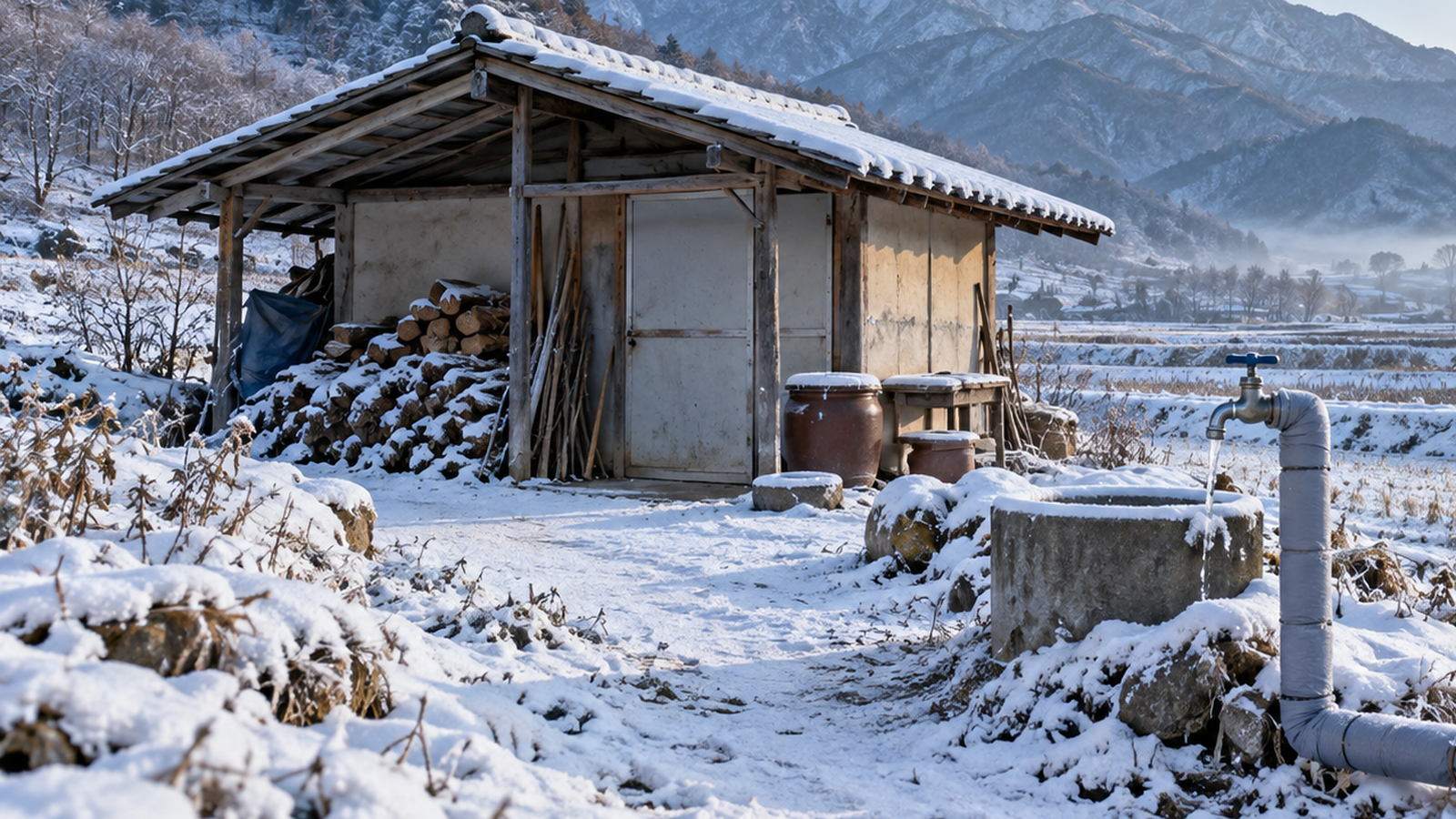
Online prices on October 15, 2026 for 25 kg bags of calcium chloride deicer and for hand and push spreaders in Korea, how to work out how far one bag goes from the label rate, what the Seoul city government says about calcium chloride, tree and garden damage noted by the Korea Forest Service, corrosion, storage and handling, and who must clear snow in front of a building.
Buy calcium chloride after the first snow and you are already late. Village grit bins empty fast and online orders pile up the day after a storm. Rural driveways and farm-shed tracks are often sloped and shaded, so ice can stay for days. Here is what a bag costs, how far it goes, and what it does to gardens, trees and cars, using official sources and today’s prices.
Bottom line: On October 15, 2026, 25 kg bags of deicing calcium chloride (labelled 74%) sold online for KRW 11,400–16,230; bead-type bags were KRW 30,400–31,000. Calcium chloride gives off heat as it dissolves and resists refreezing better than salt, but it corrodes iron (Seoul city). No official household rate per square metre was found, so use the rate printed on the bag. Do not pile snow mixed with deicer under trees or onto garden beds (Korea Forest Service).
Earlier notes: preventing frozen pipes at a farm shed, choosing a leaf blower, cordless chainsaw guide 2026.
1. Prices on October 15, 2026
| Type | 25 kg price | Note |
|---|---|---|
| Deicing calcium chloride 74% (flake) | KRW 11,400–16,230 | Most common |
| Bead-type calcium chloride | KRW 30,400–31,000 | Flows better through spreaders |
| Domestic-labelled deicing | KRW 32,610 | One product |
| ”Eco” deicer | KRW 20,480 | One product, ingredients vary |
| Food or agricultural grade | KRW 25,000–28,500 | Different use, costs more |
For yards and driveways, the 74% deicing grade is enough.
2. Calcium chloride vs salt
Seoul’s media hub (December 2025) says calcium chloride releases a little heat when it dissolves, resists refreezing better than sodium chloride, corrodes iron, absorbs moisture readily, should not touch skin, and should be used only in the amount needed. No official figures were found for the lowest working temperature of calcium chloride or of eco deicers, so check the package.
3. How far does one bag go?
We could not access the official road de-icing manual and found no official household rate. Divide 25,000 g by the rate on the bag to get area, then by driveway width to get length. The rates below are examples to show the arithmetic.
| Label rate (example) | Area per 25 kg | Length of a 3 m driveway |
|---|---|---|
| 20 g per m² | 1,250 m² | about 417 m |
| 40 g per m² | 625 m² | about 208 m |
| 60 g per m² | 417 m² | about 139 m |
Start with slopes, shade, steps and gates. In January 2026 Seoul spread deicer in advance on bridges, overpasses and shaded stretches when rain or snow was forecast around −5 °C; the same idea works for a home driveway.
4. Choosing a spreader
| Type | Oct 15 price | Fits |
|---|---|---|
| Hand crank | KRW 14,500–21,500 | Yards, steps, short drives |
| Push type 45–46 L | KRW 159,990–197,000 | Drives of tens of metres, farm tracks |
| 80 L or powered | KRW 137,000–389,400 | Large farm roads, shared village use |
Most push spreaders also handle fertiliser, seed and sand. Rinse and dry them after spreading calcium chloride because metal parts rust. Flakes clump and jam spreader holes; beads flow better. Shovel first and spread only on remaining ice to use less.
5. Trees, gardens, concrete and cars
The Korea National Arboretum webzine explains that calcium chloride building up in soil makes it alkaline and hinders roots from taking up water and nutrients, with damage showing as leaf scorch when it warms up in March. Sensitive trees include horse chestnut, wild cherry, fringe tree, zelkova and dogwood; pine, ginkgo and white pine are tolerant. The Korea Forest Service and National Institute of Forest Science (December 2025) advise spreading away from trees, not piling treated snow under them, and using sand. Do the same for vegetable beds and fruit trees, and rinse soil in spring.
Seoul notes that calcium chloride corrodes iron. Spread thinly on driveways, sweep up white residue after the melt, wash the underside of the car at winter’s end, and wipe metal gates and posts.
6. Storage, handling and the law
A manufacturer safety data sheet says to keep containers sealed, that dissolving releases significant heat, and that contact with wet skin can cause irritation or burns. Tie off open bags and store them inside a second container, wear rubber gloves, and keep it away from children and pets.
Article 27 of the Natural Disaster Countermeasures Act makes building managers responsible for clearing snow from adjacent sidewalks and back lanes, with details set by local ordinance. Incheon’s guidance, for example, gives three hours after snow stops, or 11 a.m. the next day for overnight snow. Village grit bins are free to use; ask your local community centre where they are.
References
- Seoul Media Hub (December 2025), calcium chloride and grit bins: mediahub.seoul.go.kr, grit bins
- Seoul Media Hub (January 14, 2026), pre-spreading on vulnerable sections: mediahub.seoul.go.kr
- Korea National Arboretum webzine (2013), deicer damage to street trees: forest.go.kr
- Korea Forest Service and National Institute of Forest Science (December 26, 2025): korea.kr
- Natural Disaster Countermeasures Act, Article 27: law.go.kr
- Incheon Metropolitan City, snow clearing guidance: incheon.go.kr
- Fisher Scientific, Calcium Chloride MSDS: umd.edu copy
- Online prices: Coupang Partners product list, checked October 15, 2026.
- Actual amounts vary with temperature, snowfall, surface and the product label.