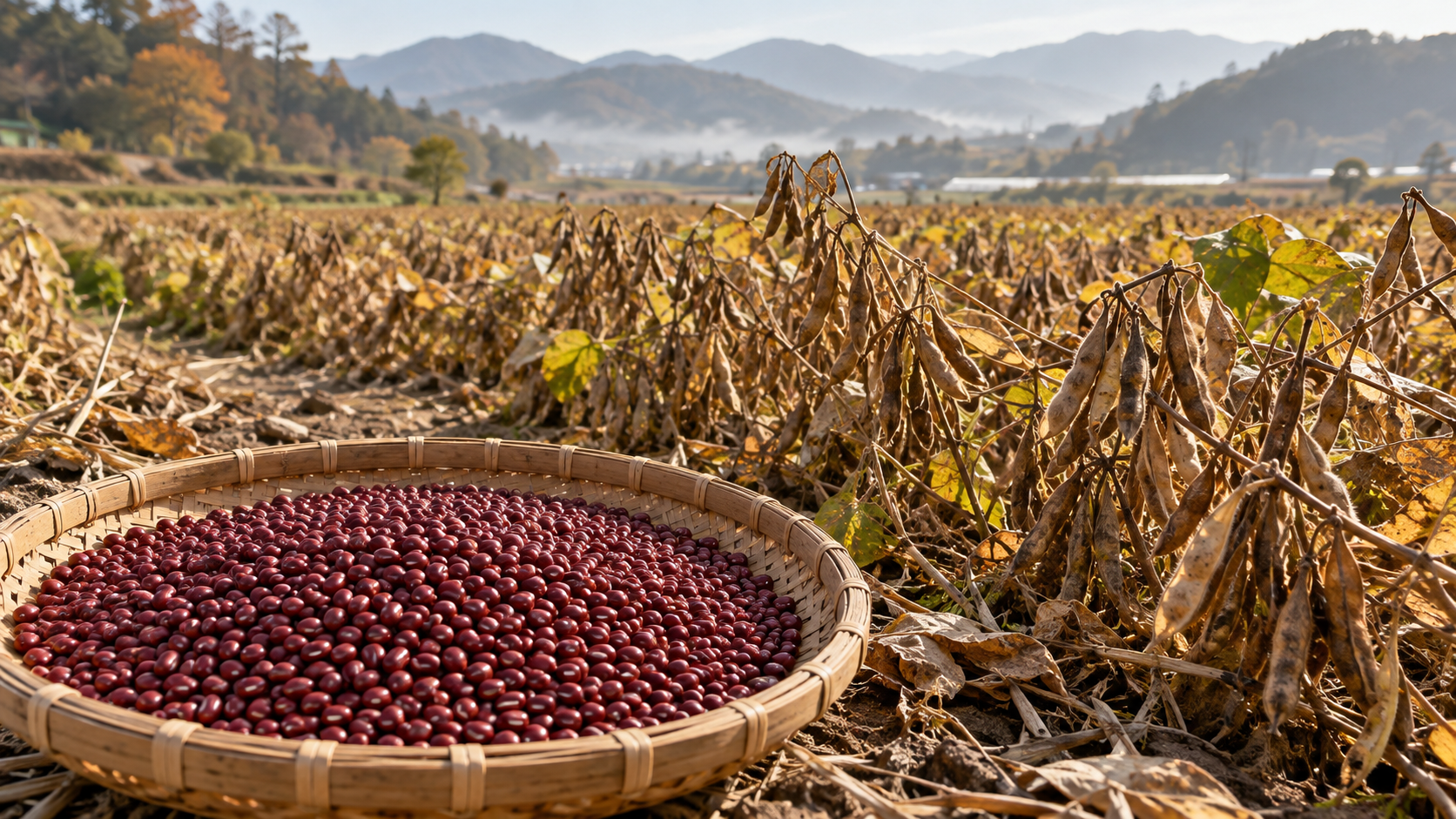
When to harvest Korean red beans (adzuki) by Nongsaro and RDA criteria, when the new crop reaches buyers, the KAMIS wholesale price per kilogram on October 8, 2026, online domestic and imported prices on October 10, and how growers dry, store and sell.
When red bean pods start turning yellow, two searches rise in Korea. Growers ask when to cut, and households preparing winter-solstice red bean porridge ask when the new crop arrives and what a kilogram of domestic beans costs.
Bottom line: Harvest red beans in one pass when 70–80% of pods are ripe: early to mid-October in central and northern Korea, mid to late October in the south (Nongsaro). On October 8, 2026, domestic red beans (grade A, 40 kg) sold for KRW 724,000 at Seoul wholesale, about KRW 18,100 per kilogram. Online on October 10, most domestic 1 kg packs cost KRW 15,000–18,000, a pack labeled 2026 new crop cost about KRW 24,200, and imported beans cost about KRW 5,000 per kilogram.
Earlier record: the 40 kg wholesale trend and selling decision are in Red Bean Price Outlook, October 2026.
1. When to harvest
Nongsaro’s red bean work calendar says to harvest all at once when 70–80% of pods are ripe, about 50–55 days after flowering. Red beans keep flowering, so waiting for every pod means the earliest pods split in the field. For home gardens, the RDA simply says to pick from mid to late October once pods turn yellow.
Variety matters. In the RDA variety table, Hongeon is early (maturity mid-September) and Arari is mid-season (late September). Arari, used for bean paste, covers more than 30% of Korea’s red bean area.
2. When does the new crop reach buyers?
Cut beans are dried for 4–6 days before threshing, then sorted and packed. A mid-October harvest in central Korea therefore reaches shoppers in late October at the earliest, mostly in November. On October 10, most domestic 1 kg packs online were still the 2025 crop. Check the production year on the product page.
3. What does 1 kg cost?
KAMIS wholesale prices on October 8, 2026 (domestic grade A and imported grade B, 40 kg):
| City | Domestic 40 kg | Per kg | Imported 40 kg | Per kg |
|---|---|---|---|---|
| Seoul | KRW 724,000 | about KRW 18,100 | KRW 267,000 | about KRW 6,675 |
| Busan | KRW 670,000 | about KRW 16,750 | KRW 260,000 | about KRW 6,500 |
| Daegu | KRW 761,000 | about KRW 19,025 | KRW 308,000 | about KRW 7,700 |
| Gwangju | KRW 543,000 | about KRW 13,575 | KRW 246,000 | about KRW 6,150 |
| Daejeon | KRW 585,000 | about KRW 14,625 | KRW 228,000 | about KRW 5,700 |
| Five-city avg | KRW 656,600 | about KRW 16,415 | KRW 261,800 | about KRW 6,545 |
Seoul has held at KRW 724,000 since September, 11.7% below a year earlier (KRW 820,000). Daily prices are on the red bean price page and the imported red bean page.
Online prices checked on Coupang on October 10 (before coupons): domestic 1 kg packs at KRW 15,490, 15,900, 16,900 and 17,500 (2025 crop); a 2026 new-crop pack from Anheung, Gangwon, at KRW 24,210; imported 2 kg packs at KRW 9,200–9,900 (about KRW 4,600–4,950 per kg).
4. Before cooking
We found no official RDA or food-safety guidance on soaking time, boiling time or whether to discard the first boiling water. Discarding it is a taste choice some cooks make to reduce astringency. Taste-test a few beans as you go, since new-crop and older beans cook at different speeds.
5. Drying and storage for growers
| Step | Standard | Source |
|---|---|---|
| Harvest | One pass at 70–80% ripe pods | Nongsaro |
| Drying | 4–6 days, seed moisture 20% or below | Nongsaro, Chungbuk ARES |
| Storage | 8°C or below | RDA (2018) |
| Room temp | Seal with one oxygen absorber and one desiccant per 500 g | RDA (2017) |
The adzuki bean weevil lays eggs on pods in the field and larvae enter the seeds, so infested beans can emerge in storage. The RDA recommends cold storage at 8°C or below. In a 2017 RDA trial, sealing 500 g of beans with an oxygen absorber and desiccant cut weevil emergence from 17.7% to 3.7%.
6. Where and how growers can sell
Reference numbers: five-city wholesale average about KRW 16,415 per kg; online domestic 1 kg packs KRW 15,000–18,000 before packing, shipping and fees; and the government stockpile purchase price for 2024-crop grade 1 red beans, KRW 5,960 per kg, as a floor reference. Selling the 2026 crop before the December solstice demand lets growers use the “new crop” label, which sold for KRW 6,000+ more per kilogram online. Dry to 20% moisture or below and remove damaged beans first. Wholesale consignment fees for grains are capped at 2%.
Whether prices fall after harvest depends on the crop. From October to November, Seoul’s monthly average rose from about KRW 460,000 to 563,000 in 2024, fell from 820,000 to 794,000 in 2025, and was flat in 2023.
References
- Nongsaro red bean work calendar: nongsaro.go.kr
- Chungbuk Agricultural Research and Extension Services, red bean cultivation: ares.chungbuk.go.kr
- RDA press release (May 30, 2022), garden red beans and variety table: korea.kr
- RDA press release (August 9, 2018), weevil damage and cold storage: korea.kr
- Korea Policy Briefing (October 26, 2017), sealed storage trial: korea.kr
- MAFRA press release (April 2, 2024), 2024 red bean stockpile purchase price: korea.kr
- aT KAMIS wholesale prices, red bean domestic grade A and imported grade B, 40 kg, five cities, survey of October 8, 2026; KAMIS monthly averages 2022–2026.
- Online prices: Coupang red bean listings, checked October 10, 2026, before coupons.