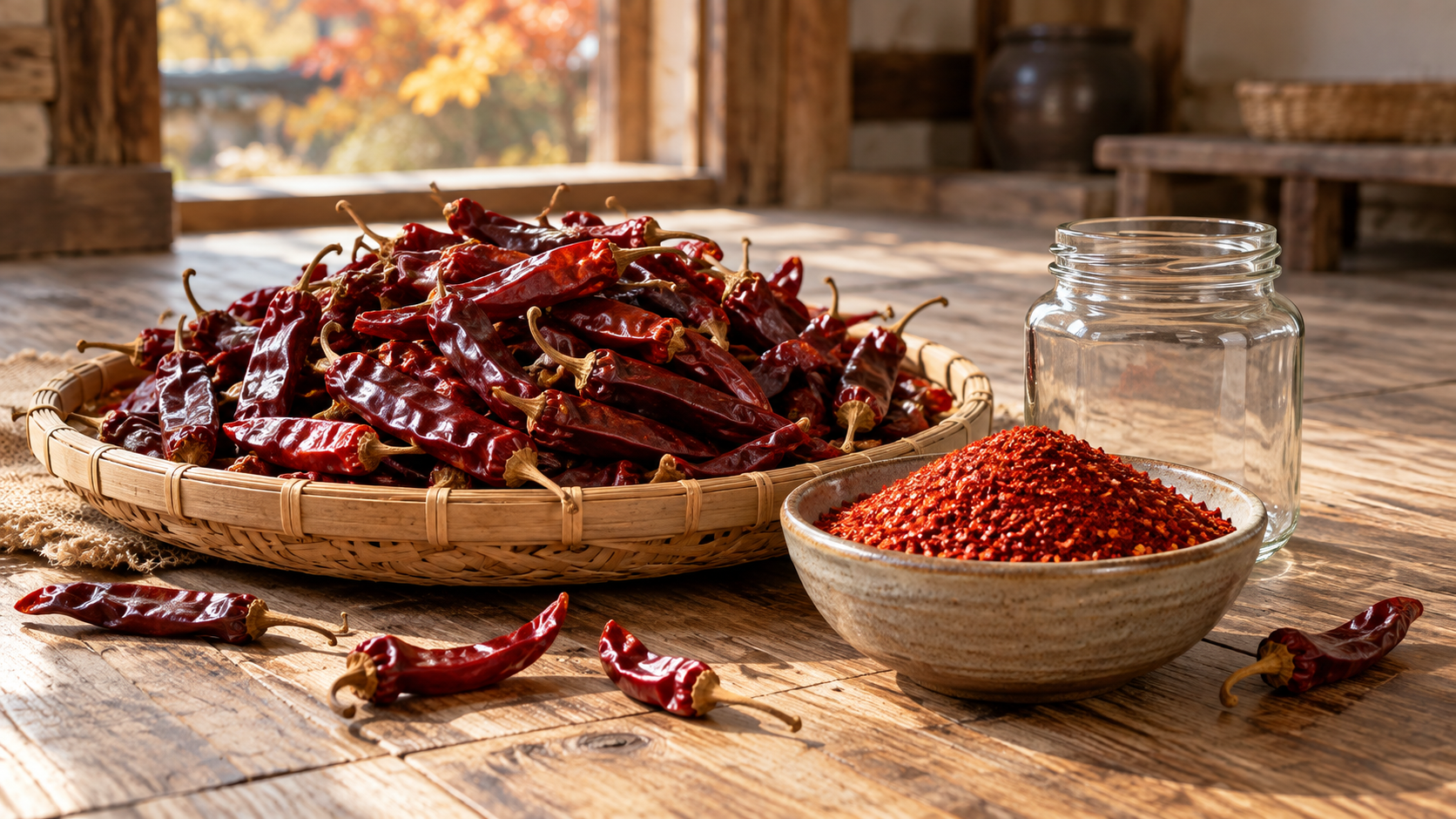
KAMIS retail data for September 2026: domestic and Chinese gochugaru prices per kilogram, why November was cheaper than October in 7 of the last 10 years, buying dried peppers to grind, and whether growers should sell dried peppers or powder.
Chili powder is usually the first thing Korean households buy once they set a kimjang (kimchi-making) date. Cabbage can wait until the last week, but gochugaru is something people like to secure early from a source they trust. This year, the news came first from fresh red chili peppers, whose wholesale price jumped several times over within a month. The natural question is whether chili powder will follow, and whether to buy now or wait until November.
Bottom line: In the KAMIS retail survey, domestic gochugaru (top grade, 1 kg) averaged KRW 35,133 in Seoul in September 2026, almost the same as KRW 35,808 a year earlier. Chinese chili powder was KRW 14,000, about 40% of the domestic price. In 7 of the 10 years from 2016 to 2025, the November average was lower than October, and in each of the last three years it fell by more than 10%.
1. What does 1 kg of domestic gochugaru cost now?
KAMIS surveys retail stores for domestic and Chinese chili powder in 1 kg units. September 2026 averages across five cities:
| City | Domestic 1 kg (Sep 2026) | Domestic 1 kg (Sep 2025) | Chinese 1 kg (Sep 2026) |
|---|---|---|---|
| Busan | KRW 36,045 | KRW 33,828 | KRW 12,335 |
| Seoul | KRW 35,133 | KRW 35,808 | KRW 14,000 |
| Gwangju | KRW 33,987 | KRW 29,703 | KRW 10,500 |
| Daejeon | KRW 33,967 | KRW 31,242 | KRW 14,150 |
| Daegu | KRW 31,950 | KRW 30,188 | KRW 12,200 |
The five-city average for domestic powder is KRW 34,216, 6.4% higher than KRW 32,154 a year ago. Seoul is slightly lower than last year, while Gwangju is up 14% and Busan up 7%.
In Seoul, the price started 2026 at KRW 33,387 in January and has stayed between KRW 35,000 and 37,000 since February. August (KRW 37,153) was the high so far; September was KRW 35,133, and the October 1–6 survey average is KRW 34,611. Even though fresh red chili prices surged from mid-September, retail chili powder did not follow.
The reason is the raw material. Gochugaru is made from dried peppers, not fresh ones. In Seoul wholesale markets, fire-dried peppers (top grade, 30 kg) went from KRW 657,000 in July and August to KRW 675,000 on September 1, a 2.7% rise, and stayed there through October 6. The fresh-pepper side is covered in Red Chili Pepper Prices, October 2026.
2. Domestic vs. Chinese: a 2.5x gap.
In Seoul, domestic powder is KRW 35,133 and Chinese is KRW 14,000, a 2.5x difference. Over ten years, the Chinese price crept from about KRW 11,000 to the 14,000 range without large swings, while domestic powder moved between the low 20,000s and close to 40,000.
A gap this wide invites fraud, and cases of Chinese powder sold as domestic are caught every year. Korea’s National Agricultural Products Quality Management Service uses microscope analysis to identify the origin of chili powder. False origin labeling can lead to up to seven years in prison or a fine of up to KRW 100 million under Korea’s Act on the Origin Labeling of Agricultural and Fishery Products.
- If “domestic” 1 kg is under KRW 20,000, double-check the origin and harvest year. That is more than 40% below this year’s five-city retail average.
- Look for origin, harvest year (2026 crop), and the producer or processor address on the package.
- When buying directly from a farm, ask to see the dried peppers, or buy dried peppers and have a local mill grind them.
3. Buy in October or November?
Looking at Seoul retail prices for domestic gochugaru month by month over 2016–2025, October is the most expensive month relative to the annual average: 3.4% above it, while November is 1.2% below. Kimjang demand appears to concentrate in October.
| Year | October avg (Seoul, 1 kg) | November avg | Oct → Nov |
|---|---|---|---|
| 2016 | KRW 21,969 | KRW 20,414 | −7.1% |
| 2017 | KRW 29,281 | KRW 34,028 | +16.2% |
| 2018 | KRW 33,275 | KRW 32,031 | −3.7% |
| 2019 | KRW 28,861 | KRW 25,979 | −10.0% |
| 2020 | KRW 36,513 | KRW 36,973 | +1.3% |
| 2021 | KRW 36,422 | KRW 33,096 | −9.1% |
| 2022 | KRW 32,040 | KRW 32,136 | +0.3% |
| 2023 | KRW 37,265 | KRW 32,324 | −13.3% |
| 2024 | KRW 37,283 | KRW 31,771 | −14.8% |
| 2025 | KRW 34,156 | KRW 30,537 | −10.6% |
November was cheaper in 7 of 10 years. Of the three exceptions, 2020 and 2022 were within about 1%. Only 2017 saw a real rise, climbing steadily from KRW 22,833 in September to KRW 34,028 in November.
So if your kimjang is in mid-November or later, there is no need to buy everything in October. Buy about 1 kg first to check color and heat, then buy the rest after seeing November prices. This is the Seoul retail average, though; farm-direct and local mill prices can move differently.
One risk remains. In January, the Korea Rural Economic Institute surveyed 2026 dried-pepper planting intentions at 25,014 ha, 2.8% below last year and 9.9% below the normal-year average. With less area planted, how much the new crop pulls kimjang-season prices down will only be clear from November prices.
4. Is it cheaper to buy dried peppers and grind them?
KAMIS retail data puts Seoul fire-dried peppers (top grade, 600 g) at KRW 18,152 in September 2026, or about KRW 30,250 per kilogram. That looks about KRW 4,900 cheaper than 1 kg of domestic gochugaru.
The comparison is misleading on its own. Dried peppers still have stems and seeds. Depending on how much seed is removed, the same weight of dried pepper yields less powder, and the mill charges a grinding fee. Seed ratios and fees vary by mill, so this article does not pin them to a single number. Ask your mill how many grams of powder come from a given weight of peppers and what they charge, and the real difference becomes easy to calculate.
The main reason to buy whole dried peppers is control, not price: you can see the shape, color, and any mold, and choose heat and grind size.
Chili powder fades and clumps with moisture and light. If you buy a large amount, split it into smaller containers in the fridge or freezer and take out only what you need.
5. Growers: sell dried peppers or powder?
New-crop dried peppers reached wholesale markets in mid-August. In Seoul, new-crop fire-dried peppers (top grade, 30 kg) opened at KRW 725,000 on August 14 and settled at KRW 675,000 from August 21. The new-crop series runs through August 31; from September KAMIS reports a single fire-dried series. On October 6, top-grade 30 kg was KRW 675,000 in Seoul, 700,000 in Busan, 725,000 in Gwangju, 683,000 in Daejeon, and 583,000 in Daegu.
Seoul’s price works out to KRW 22,500 per kilogram, while domestic gochugaru retails at KRW 35,133 per kilogram in the same city. On paper, selling powder directly earns more than KRW 10,000 extra per kilogram. In practice:
- Wholesale figures are intermediate wholesaler selling prices; growers receive less at auction.
- Grinding loses the weight of stems and seeds, so 1 kg of saleable powder takes more than 1 kg of dried peppers.
- Grinding fees, small packaging, shipping, and time spent on direct customers all add up.
- Hygiene matters for powder sold to customers. Drying temperatures recommended by Korea’s Rural Development Administration are in our food dehydrator and pepper dryer guide. Check required registrations and labeling with your local government before selling processed powder.
| Situation | Decision |
|---|---|
| Large volume, few direct customers | Sell dried peppers to wholesale markets or buyers |
| Regular direct customers | Turn part of the crop into powder in 1 kg or 500 g packs |
| Big price gaps between cities | Daegu KRW 583,000 vs. Gwangju KRW 725,000; ask each outlet for recent auction prices first |
| Red peppers still in the field | Consider selling some fresh while fresh prices are high |
Fresh red chili peppers were still KRW 192,000 per 10 kg (top grade) in Seoul on October 6, with a five-city average of KRW 121,660. Whether to dry or sell fresh is safest decided by splitting, after counting drying costs and labor.
6. Conclusion
In September 2026, 1 kg of domestic gochugaru cost KRW 35,133 in Seoul, about the same as last year. Fresh chili prices jumped, but dried peppers, the actual raw material, rose only 2.7%. Over ten years October has been the priciest month and November usually cheaper, so late-kimjang households can buy part now and the rest later. Growers should judge powder sales by the real margin after weight loss, processing, and packaging, not the headline gap.
References
- aT KAMIS monthly retail and wholesale prices (data.go.kr, Korea Agro-Fisheries & Food Trade Corporation API): chili powder domestic and Chinese 1 kg, fire-dried pepper 600 g retail, Seoul, Busan, Daegu, Gwangju, Daejeon, January 2016 to October 2026 (October through the 6th).
- aT KAMIS daily intermediate wholesaler prices: fire-dried and new-crop fire-dried pepper 30 kg, red chili pepper 10 kg, September 2025 to October 6, 2026.
- Nongmin Shinmun, “Agricultural Outlook 2026,” January 24, 2026 (Korea Rural Economic Institute 2026 dried-pepper planting intentions).
- Newsis, August 5, 2019 (National Agricultural Products Quality Management Service origin testing of chili powder).
- Act on the Origin Labeling of Agricultural and Fishery Products, penalties for false labeling.
- IMUN.FARM
/prices/dried-red-pepper/(KAMIS daily wholesale prices). - Actual prices vary by variety, heat, grind, harvest year, and seller.